
Olmsted County Arrest Records and Charges
Arrest records in Olmsted County are tied first to law enforcement and custody. The Olmsted County Sheriff's Office operates from the Law Enforcement Center in Rochester and the Adult Detention Center lists current detainees when public information is available. A roster entry may show a photo, name, booking date, incarceration reason, status, charge descriptions, and offense level. That custody record is not a final court outcome.
Court charges after arrest are the formal accusations filed into the Minnesota District Court case system. For Olmsted County, the trial court is Olmsted County District Court, and Court Administration handles the records-counter role. The Olmsted County Attorney reviews law-enforcement reports and files felony complaints and some gross misdemeanor or misdemeanor matters. Some Rochester misdemeanor cases may be prosecuted by the Rochester City Attorney, but the court record still routes through District Court once filed.
Use the jail roster for current custody and booking context, then use Minnesota Court Records Online for the filed court charge record. The full case record and sentencing history are covered more broadly in Olmsted County criminal court records, while current custody belongs with the Olmsted County inmate roster.
The County Attorney Criminal Division page is shown in the manifest as the local source for prosecutor contact and role. The official Criminal Division contact page identifies the office that reviews reports and files many adult criminal complaints in Olmsted County.
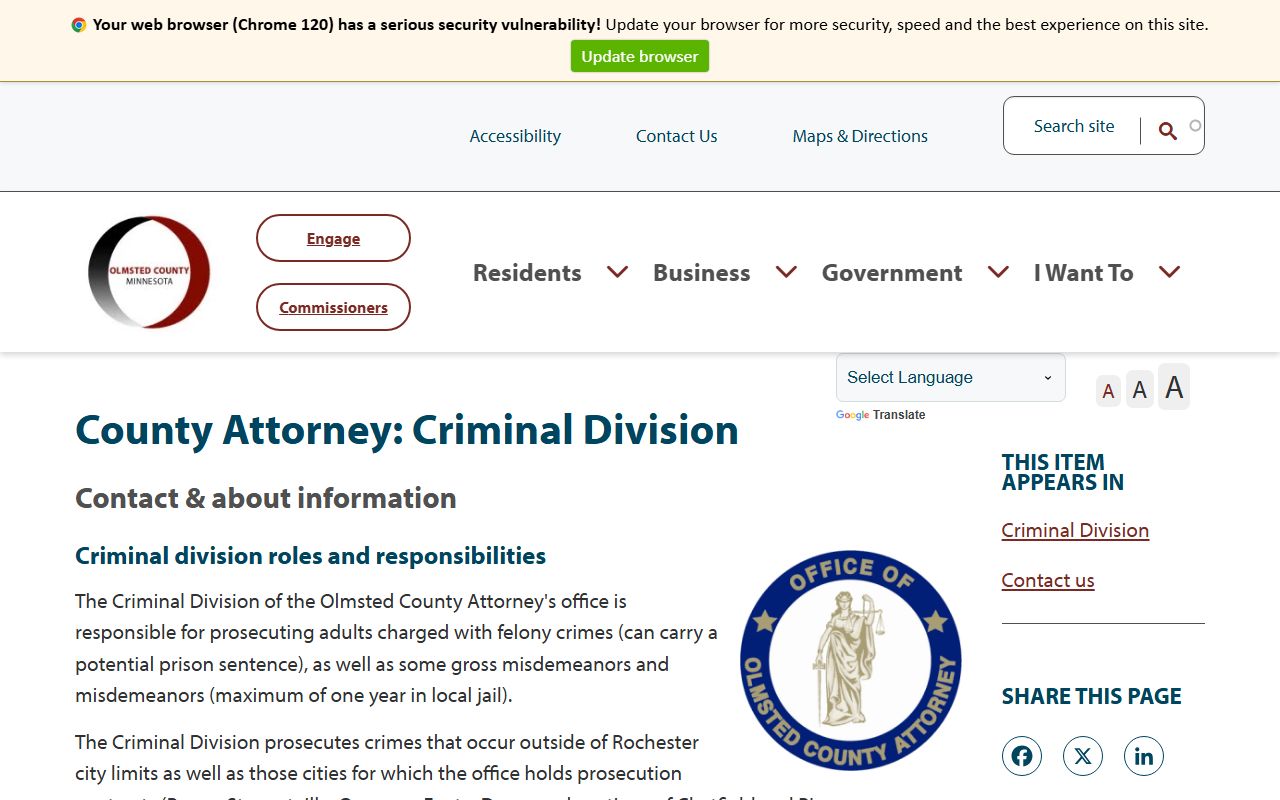
That office source matters because the sheriff may arrest or book a person, but the prosecutor decides which charges are filed in court.
Find Olmsted County Arrest Charges
There is no separate Olmsted-only court charge database. Use MCRO and filter to Olmsted County for court cases. Case Search can be searched by person name, business name, attorney name, case number, citation number, or attorney bar number. Pending criminal, traffic, and petty misdemeanor cases without convictions may not return by defendant-name search, so a case number or citation number can be more reliable when the case is recent.
- Open MCRO Case Search and accept the terms.
- Select Olmsted County as the court location when searching local charges.
- Search by defendant name, case number, citation number, attorney name, or bar number.
- Open the case details and read the charge list, Register of Actions, hearings, and public documents.
- For certified copies or records not available online, contact Olmsted County Court Administration.
For the arrest side, the ADC in-custody list is the local roster. It is useful when the person may still be held at the Adult Detention Center, but it is not a substitute for the filed District Court record. For statewide conviction history, use the Minnesota Bureau of Criminal Apprehension Criminal History Search, which is separate from MCRO and does not serve as an arrest database.
The public defender office listing is one source for defense access after charges are filed. The Minnesota Board of Public Defense office list includes the Third District Management Office in Rochester.
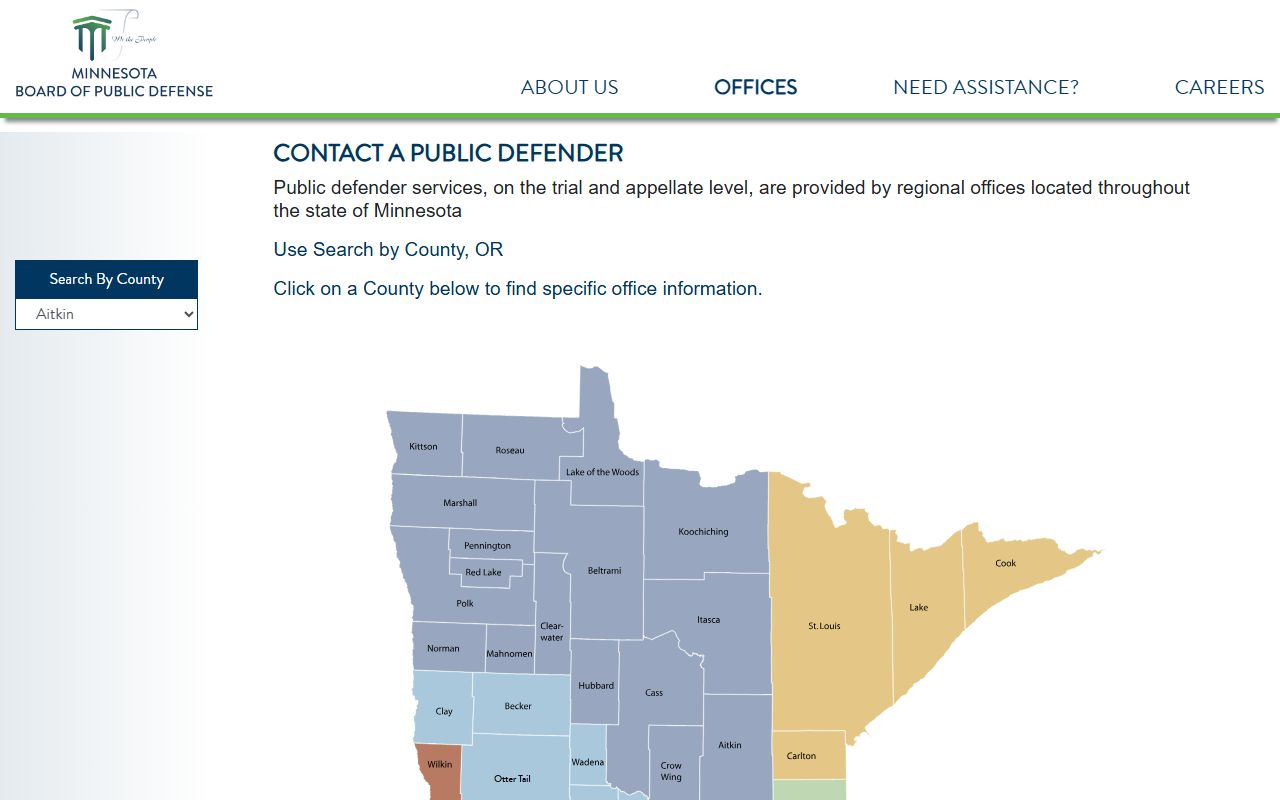
Public defender access is part of the court case process, not the arrest record itself.
The Judicial Branch explains how appointment works when jail time is possible. Minnesota public defender appointment help describes the court application and financial review process.
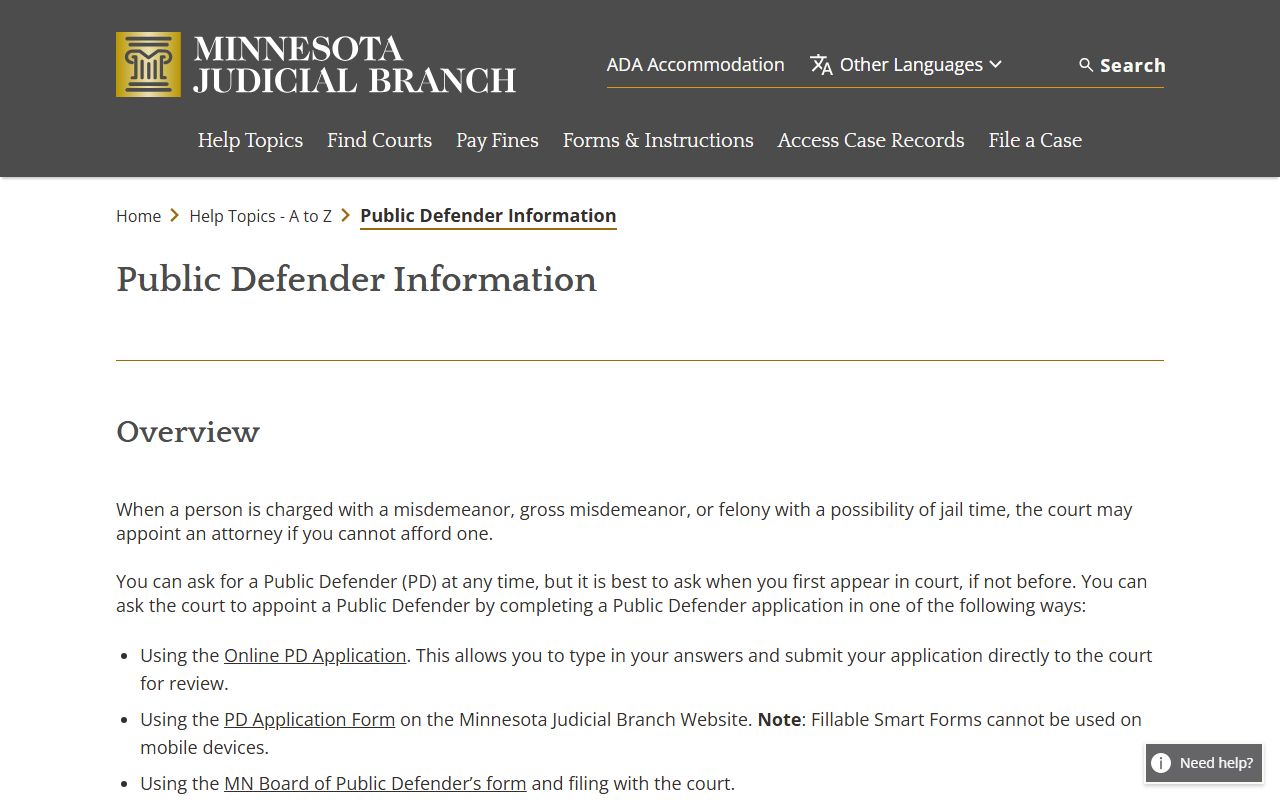
That appointment process can appear in the court file after charges are filed and the case begins moving through hearings.
Olmsted County Charge Documents
A charge record starts when an accusation becomes a court filing. In Olmsted County, the County Attorney Criminal Division handles adult felonies and some gross misdemeanor or misdemeanor cases, including cases outside Rochester and in several contract cities. The research also notes that some Rochester gross misdemeanor and misdemeanor cases may be handled by the Rochester City Attorney. Once the charging document is filed, the case appears in the District Court system if it is public and remotely available.
| Document | Who Uses It | What It Starts |
|---|---|---|
| Complaint | Prosecutor, often after review of law-enforcement reports | Common Minnesota criminal charging document in District Court |
| Information | Prosecutor | A formal accusation used in some felony procedures |
| Indictment | Grand jury | A serious felony accusation after grand jury action |
Complaint warrants can be issued when a prosecutor charges a case and the defendant presents a flight risk, cannot be found, lives out of state, or the alleged crime is serious. That warrant is a judge-signed court order, while the sheriff processes and maintains warrant data.
Olmsted County Charge Status
A single arrest can produce more than one count. Each count may move differently. One charge can remain pending while another is dismissed, reduced, or resolved by plea. MCRO case details and the Register of Actions are the best public places to track the sequence because the roster charge text may lag behind later court action.
| Status | What It Means |
|---|---|
| Pending | The accusation has not reached a final public disposition. |
| Amended or reduced | The filed accusation changed, often by prosecutor amendment, plea agreement, or court order. |
| Dismissed | The court record shows the charge ended without a conviction on that count. |
| Convicted | The record shows a guilty plea, verdict, or other conviction event. |
MCRO is not certified. Court Administration must issue certified copies of criminal proceeding instruments, certified screen prints, and exemplified copies when an official court record is needed.
Olmsted County Charges vs Convictions
A charge is an accusation. A conviction is an outcome. The difference matters in Olmsted County because the ADC roster can show charge descriptions for current custody, MCRO can show filed charges and case events, and BCA Criminal History Search is aimed at public conviction history. A person can be arrested and charged without being convicted, and a dismissed charge should not be read as a conviction.
| Point | Charge | Conviction |
|---|---|---|
| Stage | Filed accusation after arrest, citation, complaint, or warrant | Final result after plea, verdict, or qualifying court action |
| Best source | MCRO case record and public charging documents | MCRO disposition and BCA public conviction history |
| Custody link | May be listed on the ADC roster while the person is held | May lead to sentencing, probation, jail, prison, or fines |
BCA public conviction data does not include juvenile data, federal or out-of-state records, or private and confidential data. MCRO also warns that it should not be used for background checks.
State and Federal Charge Sources
Olmsted County cases are state District Court matters unless they are prosecuted federally or handled in a different system. Minnesota DOC tools can show state prison or supervision records for people committed to the Commissioner of Corrections, but those are not county arrest records. Federal custody uses the Bureau of Prisons locator, and federal criminal court files use PACER and federal court CM/ECF systems.
The image manifest also includes federal PACER and bankruptcy court sources for comparison. PACER's bankruptcy court lookup is not an Olmsted County arrest source, but it illustrates that federal court records use a different case-access system.
Keep federal case searches separate from Olmsted County District Court charges unless the case was actually filed in federal court.
Federal bankruptcy filings use their own electronic filing system. The Bankruptcy Court CM/ECF login is a court-record access channel, not a criminal charge lookup.
This distinction helps prevent a federal civil or bankruptcy record from being confused with a local criminal charge.
The U.S. Bankruptcy Court itself is also separate from local criminal prosecution. The District of Minnesota Bankruptcy Court does not maintain Olmsted County arrest records.
Use these federal sources only when the charge or case is federal, not when checking a county arrest-to-charge path.
Restricted Olmsted County Charge Records
Minnesota court access rules make many court records public, but remote access is narrower than courthouse access. Rule 2 of the Minnesota Rules of Public Access sets the general presumption of access. Rule 4 lists inaccessible categories, including adoption, restricted juvenile records, restricted identifiers, and certain medical or commitment materials. Rule 8 explains why some records are public at a courthouse terminal but not online.
Juvenile delinquency records, expunged cases, certain family and protective-order matters, medical records, victim and witness identifiers, and sealed records may be withheld from the public or from remote display. Minnesota chapter 609A governs criminal expungement. An expungement generally seals a qualifying record from public view, but it does not make every government use disappear.
Important: MCRO and jail roster entries are public-access tools, not certified background checks or consumer reports.