
Search Olmsted County Court Records
The official online access point is Minnesota Court Records Online, known as MCRO. It is statewide, so Olmsted County users must select the local court location or use a local case number when possible. MCRO covers District Court case details, the Register of Actions, public hearings, some online documents, and docketed money judgments. It is not an Olmsted-only database, and it is not the certified court file. The Minnesota Judicial Branch states that MCRO records and search results are not certified. Certified copies come from Olmsted County Court Administration.
The practical search path depends on what is known. A party name can work for many civil, family, probate, and closed criminal matters. A case number is better for pending criminal, traffic, and petty misdemeanor cases with no conviction, because those may not return through defendant-name search. Citation numbers can locate many ticket cases. Public courthouse terminals may also show public information that remote MCRO does not display.
- Open MCRO Case Search and accept the terms for public court record access.
- Choose the search mode that matches the known detail: person, business, attorney, case number, citation number, or bar number.
- Select Olmsted County as the court location when using a statewide name search.
- Open the matching case and review the case details, parties, hearings, Register of Actions, dispositions, and public documents.
- Contact Court Administration for certified copies, older files, records that require counter access, or help with a local case number.
The MCRO overview page shows the four main tabs used for Olmsted County court records access.
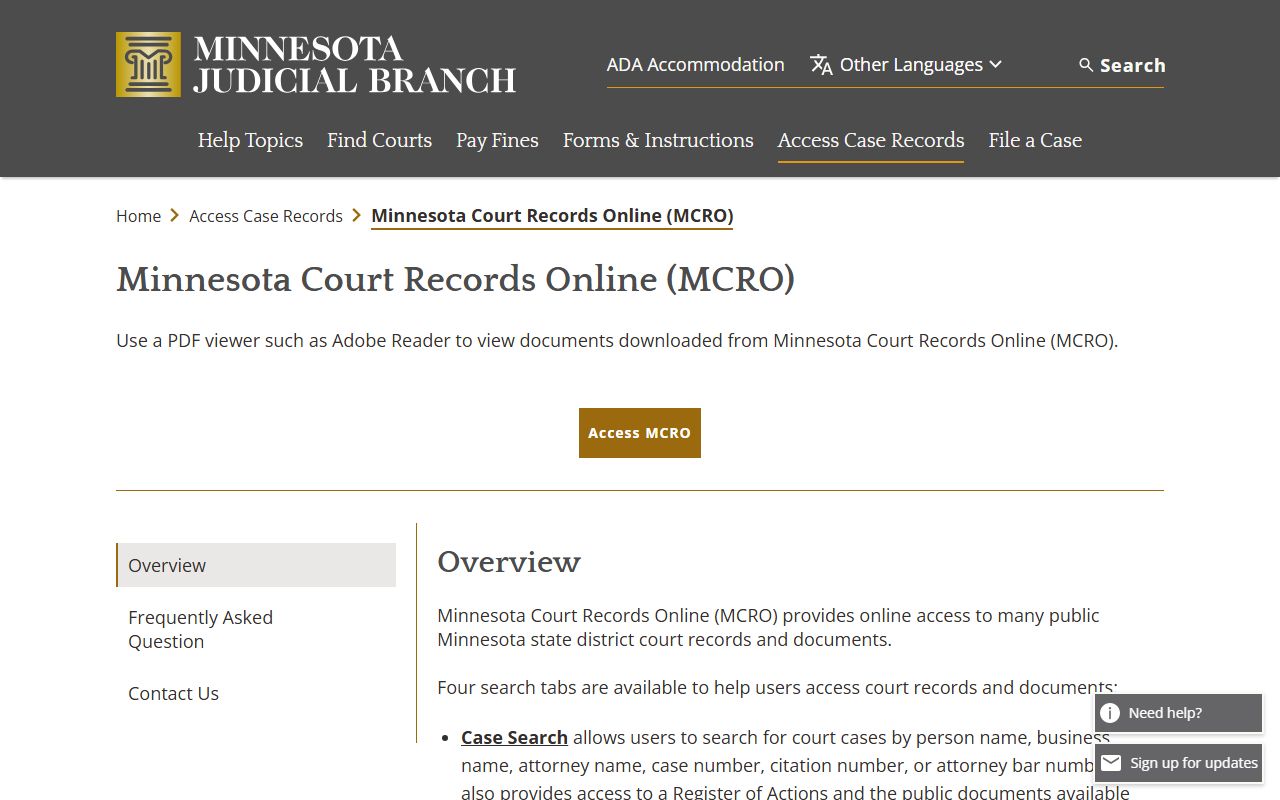
This overview matters because the same District Court system feeds case search, document search, hearing search, and judgment search for Olmsted County cases.
Olmsted Court Records Fields
MCRO is strongest when the search fields are used with the right limits. Exact names can be too narrow, while broad statewide searches can produce many matches from other Minnesota counties. For Olmsted County court records, set the court location to Olmsted when a name is common. Use the case category filter when the case type is known. Criminal, civil, family, and probate or mental health categories search different parts of the same District Court record system.
| Field Label | Type | Required | Notes / Format |
|---|---|---|---|
| Search tab | Tab | Yes | Case Search, Document Search, Hearing Search, or Judgment Search. |
| Last Name | Text | Yes for name search | Wildcard is allowed after two characters. Sounds Like cannot be combined with wildcard. |
| Date of Birth | Date | No | Useful to narrow person-name results. |
| Case Category | Dropdown | No | Civil, Criminal, Family, or Probate or Mental Health. |
| Court Location | County selector | No | Select Olmsted for local District Court records. |
| Case Number | Text | No | Use letters, numbers, and hyphens. Spaces can cause errors. |
| Citation Number | Text | No | Often a 12-digit Minnesota citation number. |
| Attorney or Bar Number | Text | No | Can locate cases or hearings tied to counsel. |
MCRO Case Search is the main name and case-number tool for Olmsted County court records.
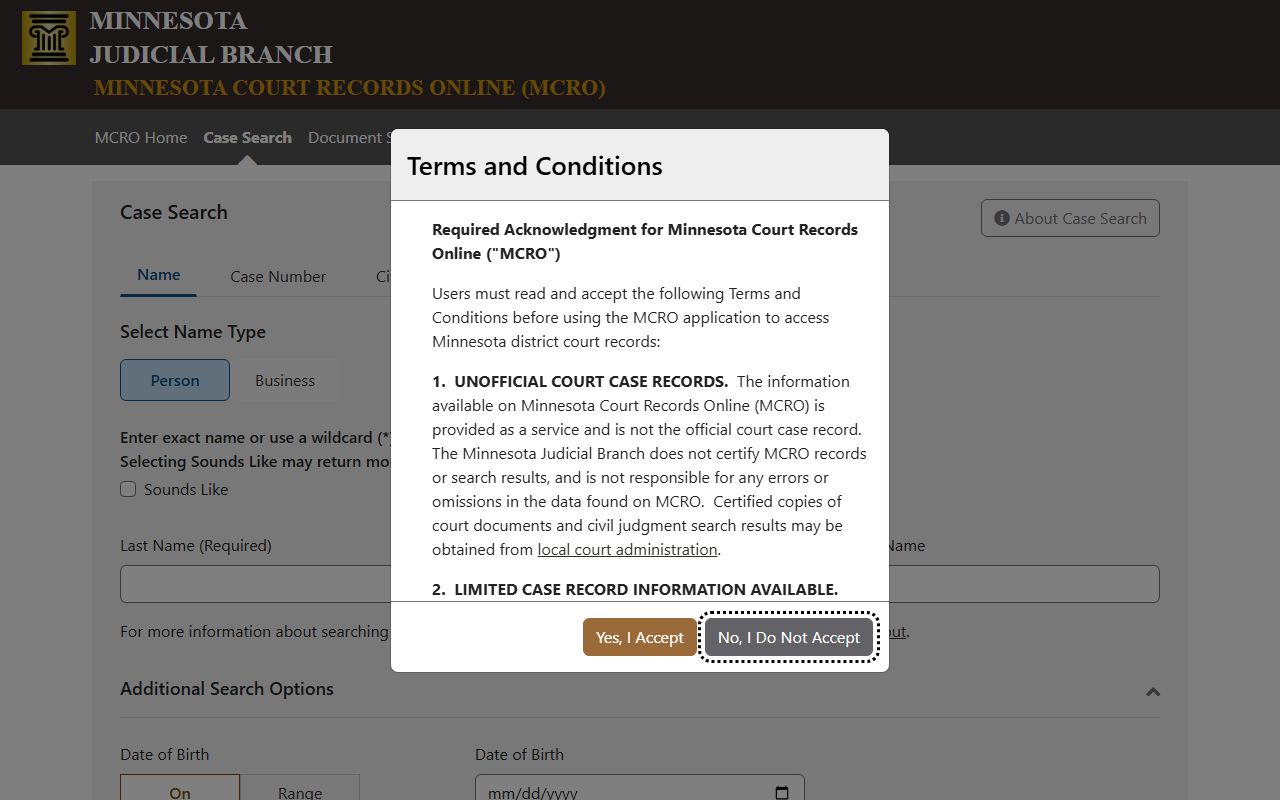
The case search screen is the best starting point when the goal is to find the overall case record before checking individual documents.
Types of Olmsted Court Records
Olmsted County District Court is the local trial court for civil, family, probate, juvenile, criminal, and traffic matters. Minnesota does not use a separate county court or justice court for Olmsted County filings. Rochester City Attorney or other city attorney prosecution can affect who filed a misdemeanor or ordinance case, but the public court record still routes through District Court once filed as a court case.
- Civil records can include contract, tort, property, eviction, conciliation, and money judgment matters.
- Criminal records can include complaints, charges, hearings, pleas, dispositions, sentencing, fines, and probation terms where public.
- Family records can include divorce, custody, paternity, support, and parenting-time filings, with remote document limits.
- Probate records can include estates, trusts, guardianships, conservatorships, and will matters in the Probate Division of District Court.
- Traffic records can include citations, petty misdemeanors, violation bureau cases, payments, and scheduled appearances.
- Juvenile, commitment, protective order, and sealed records are restricted or blocked from remote access.
The MCRO Document Search tab is narrower than case search because it works from a case number.
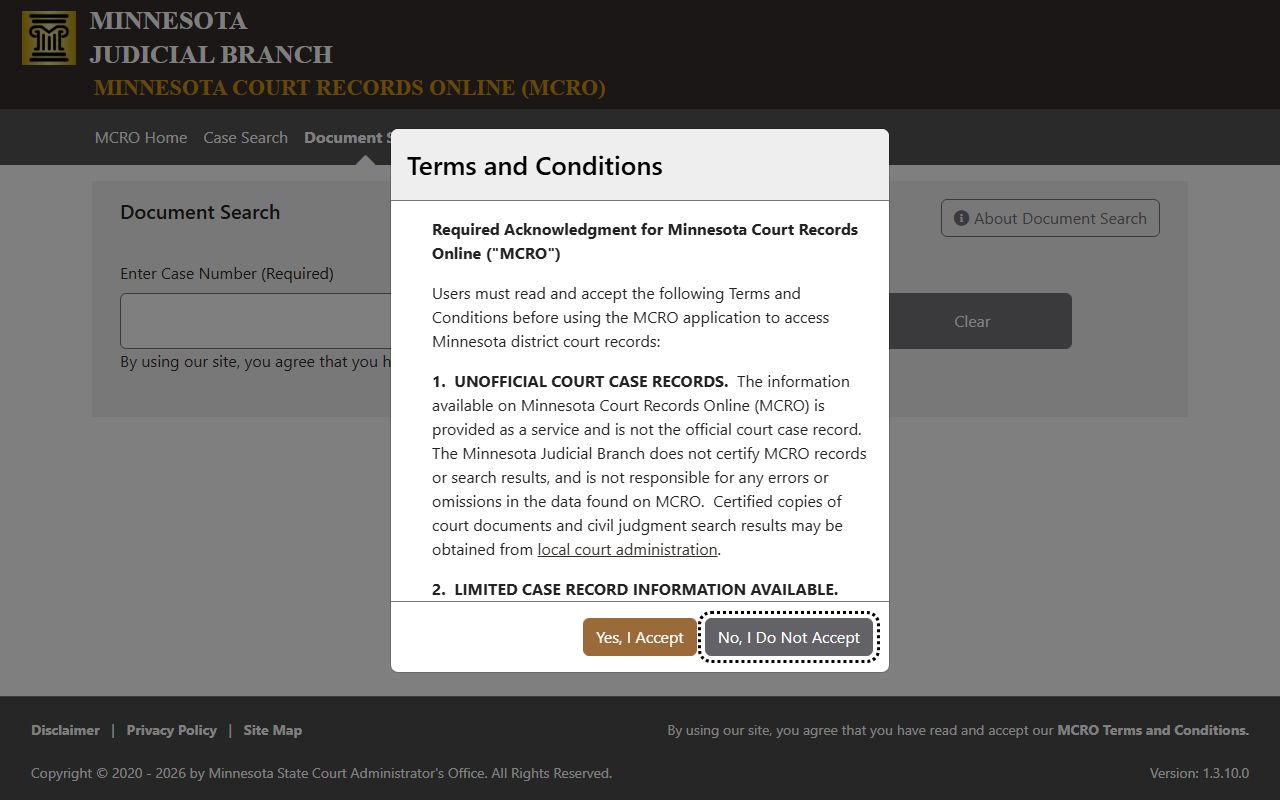
Document search is useful after a case number has been confirmed, especially when public orders, judgments, notices, or filed documents are available online.
What Olmsted Court Records Show
A Minnesota District Court case number often identifies the county, case type, filing year, and sequence number. For example, a criminal case number beginning with 55-CR points to Olmsted County and a criminal case type. A violation bureau number beginning 55-VB points to a traffic or petty matter. The Register of Actions is the event list. It tracks filings, hearings, notices, orders, dispositions, and other public case activity.
| Field | What It Shows |
|---|---|
| Case Number | County number, case type, filing year, and sequence number. |
| Filing Date | Date the initiating document or case was filed. |
| Parties | Plaintiff, defendant, petitioner, respondent, debtor, creditor, or estate parties. |
| Attorneys | Attorney name and sometimes license or bar number. |
| Hearings | Date, time, judicial officer, hearing type, location, courtroom, or Zoom setting. |
| Register of Actions | Chronological docket entries showing case events. |
| Disposition | Outcome such as dismissal, judgment, conviction, dissolution, order, or sentence. |
| Documents | Public complaints, orders, judgments, notices, and filings when remotely available. |
Note: MCRO downloads may be watermarked or signature-applied, but that does not make them certified court copies.
Olmsted Court Records Access Rules
Minnesota court access starts with the presumption in Minnesota Rule of Public Access 2: court records are open for inspection and copying unless a rule, order, or law restricts them. Rule 7 explains requests to the records custodian, and Rule 8 controls remote access. That remote-access rule is why a record can be public at a courthouse terminal but absent from MCRO at home.
County administrative data is different from court case data. Requests for sheriff records, county department records, or other noncourt county files use the Olmsted County Data Practice Request process under Minnesota Statutes chapter 13. Court case copies, certified copies, and complete court files route to Court Administration instead. The split matters because a sheriff report, an active warrant summary, and a District Court case file may concern the same person but come from different custodians.
Note: A free online court record is useful for screening, but certified copies must come from Court Administration.
Rule 2 of the Minnesota Rules of Public Access states the core open-record presumption for court records.
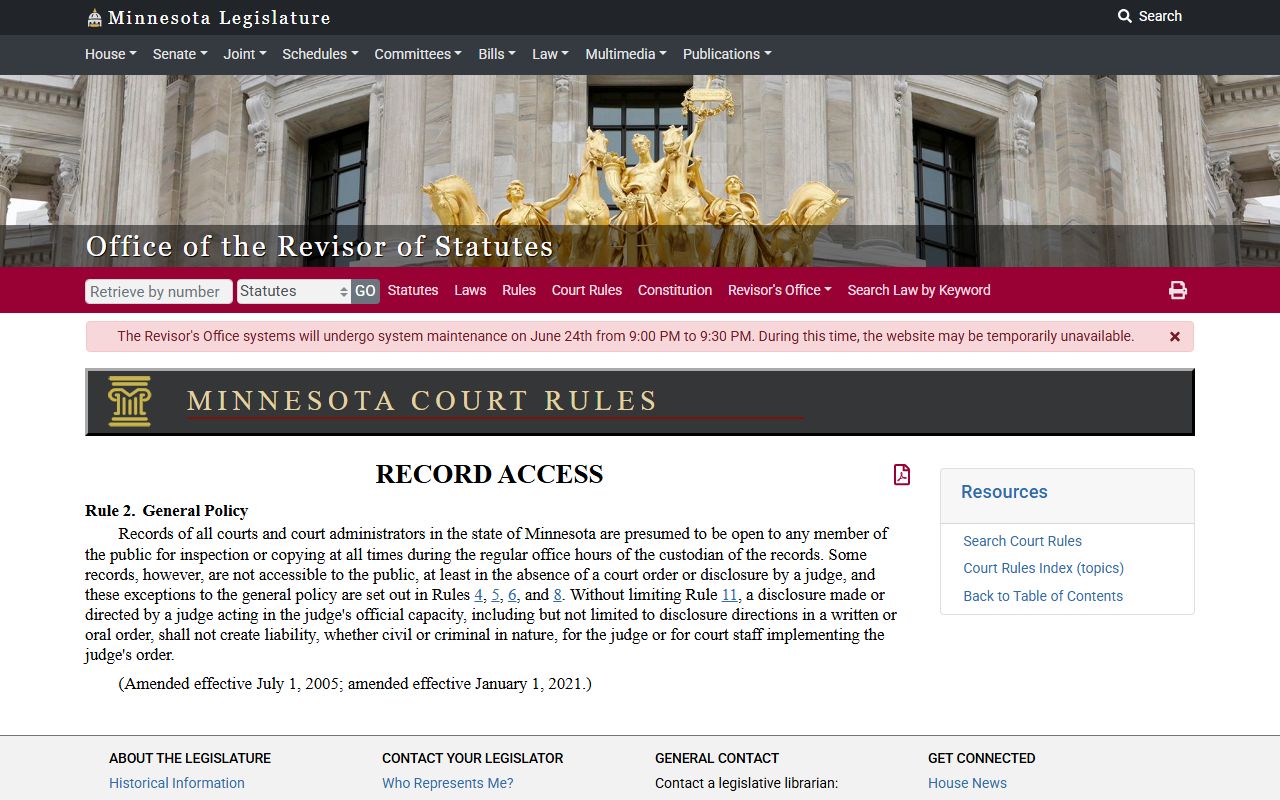
That presumption is the starting point, but the later rules and case-specific orders decide what can be seen online or at the counter.
Rule 4 lists court record categories that are not accessible to the public.
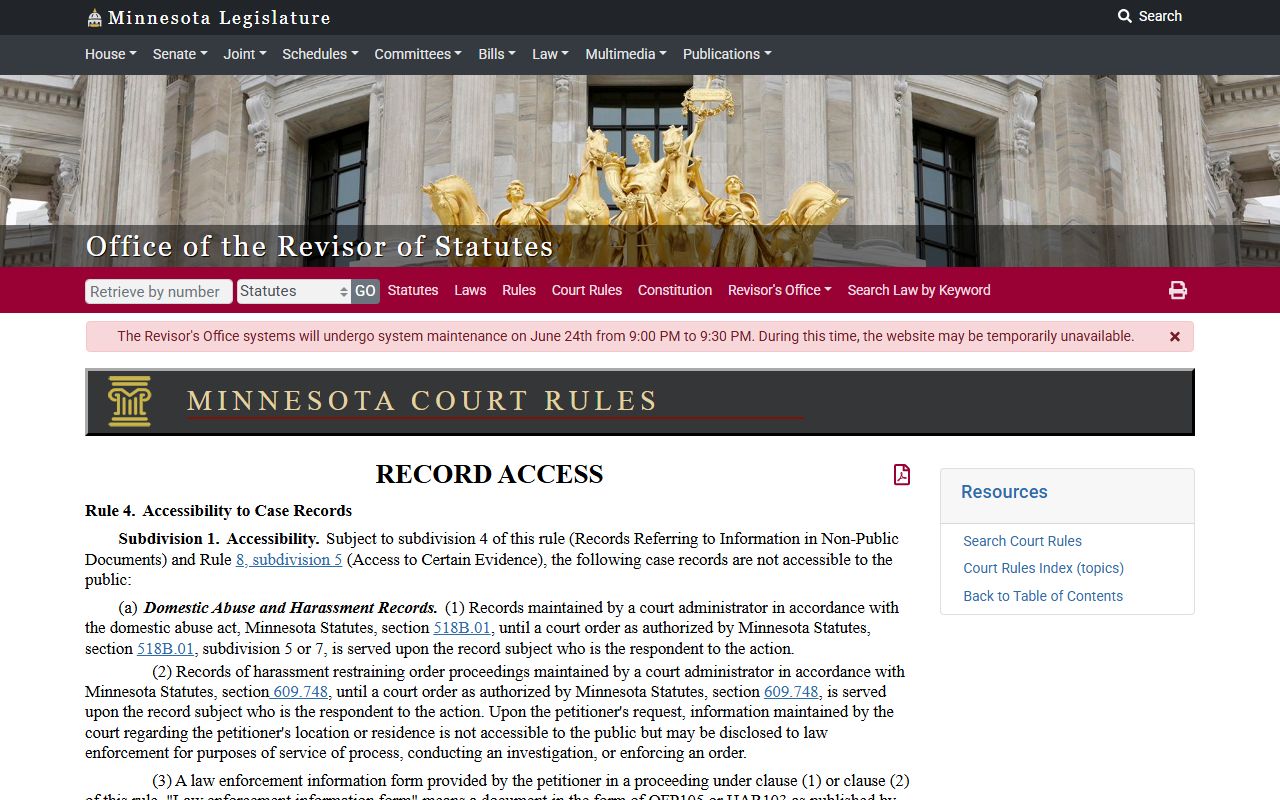
Rule 4 is the reason users should expect gaps for adoption, restricted juvenile, medical, commitment, and protected identifier material.
Rule 8 explains remote limits for Minnesota court records.
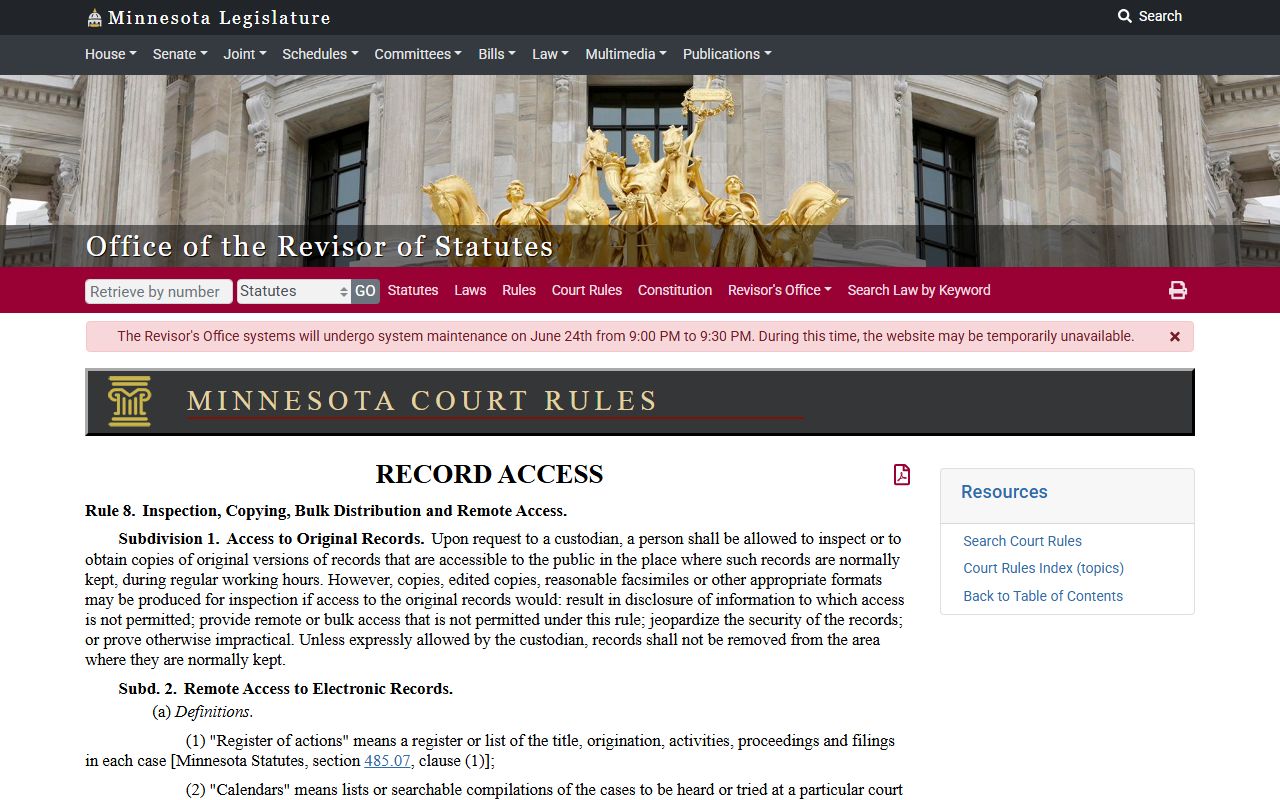
For Olmsted County court records, Rule 8 is often the answer when a public record exists but does not appear through an internet search.
Restricted Olmsted Court Records
Several categories are blocked or limited by law. MCRO does not display Child Protection or CHIPS cases, Juvenile Delinquency Felony 16 cases, domestic abuse order for protection cases, harassment restraining order cases, and some public civil commitment documents through remote internet access. Family case documents also have limits. Court-prepared orders, judgments, notices, and appellate opinions may appear when the rules allow, while party-filed family documents may not.
Criminal expungement in Minnesota is governed by chapter 609A and petition procedures in section 609A.03. An expunged Olmsted County case may not appear in MCRO. Expungement usually seals qualifying records from public view rather than deleting every government use. Juvenile delinquency record access is also controlled by section 260B.171, which allows limited releases but does not make juvenile records fully public.
Olmsted Court Record Requests
For official Olmsted County court records, certified copies, older records, and records that require courthouse-terminal access, contact Court Administration. The local court is at the same Government Center address used for many court services. Bring the case number if known, the party name, case type, approximate filing year, and a photo ID when asking about access to records that may require identity review.
Olmsted County Court Administration
151 Fourth Street SE
Rochester, MN 55904
507-722-7264
Monday-Friday, 8 a.m.-4:30 p.m.
Traffic information has a separate statewide phone line, 800-657-3611. Civil scheduling is listed at 507-722-7325, criminal scheduling at 507-722-7326, and jury administration at 507-722-7327. Those lines help route calendar or division questions, but record certification still belongs with Court Administration.